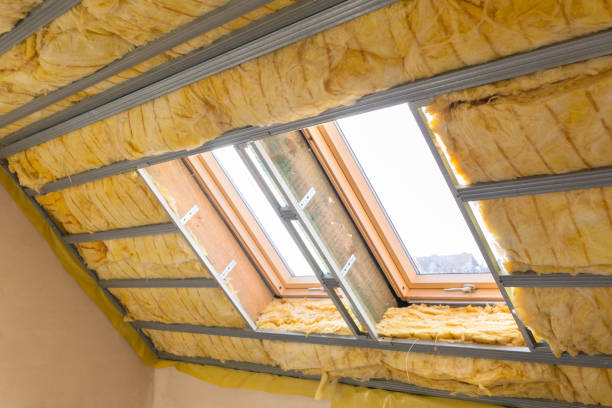
Thermal insulation
Thermal insulation refers to the insulation of roofs, roofs, terraces and basements. The right choice of thermal insulation method to be applied requires substantial knowledge and expertise. The engineers of EMEKA MG recommend after an autopsy the most suitable and economical solution. The performance, quality and lifespan of thermal insulation are always the guiding principle, in order to achieve maximum energy savings.
More specifically:
- ROOF
On the roof we find two types of thermal insulation:
- Conventional thermal insulation
- Inverted thermal insulation
Conventional thermal insulation is called the thermal insulation in which the installation of extruded polystyrene XPS thermal insulation boards is preceded on the roof slab. This is followed by laying cement mortar or lightweight concrete. Finally, it is necessary to waterproof the final surface by choosing the appropriate method.
Inverted thermal insulation is called the thermal insulation in which on the roof slab the waterproofing precedes and then follows the XPS extruded polystyrene thermal insulation boards. As the final surface we find gravel, pavement slabs or ready-made extruded polystyrene slabs with embedded ceramic tile (roof slabs).
In any case, it is necessary to protect the thermal insulation material from contact with solar radiation, which contributes to its immediate aging and wear.
- ROOFS
Thermal insulation of roofs can be done in the following ways:
- In the upper part of the pedestal.
- At the bottom of the pedestal, internally.
- In the case of the presence of a reinforced concrete slab under the roof, in the upper part of the slab.
In any case, the material that is suitable is extruded polystyrene XPS in thickness of 8cm or more or the use of stone wool.
- GATES
The thermal insulation of the pillars concerns the first floors which are in contact with the ground floor or the parking lot, presenting particularly low temperatures on the floor or even the presence of moisture in it.
This case requires thermal insulation not only of the lower part of the slab, but also of the rafters in order to avoid thermal bridges and liquefactions.
The work of thermal insulation of the pillars is the same as that of the thermal façade. The material recommended is graphite expanded polystyrene in thickness of 8cm or more or the use of stone wool.
- BASEMENTS
In the majority of cases, underground spaces are auxiliary spaces and for this reason it is not counted in the energy efficiency of a property. However, the underground spaces are made entirely of concrete, whose thermal conductivity is very high and therefore a very cold element.
In new constructions, the thermal insulation of the basements is indicated externally in continuation of the waterproofing with extruded polystyrene. A relatively economical process but with great detail.
In existing constructions, due to labor costs, external thermal insulation is an extremely expensive task. For this reason, in the majority of cases their thermal insulation is chosen internally.